The hardest classical piano pieces, measured
Every list of hard piano pieces is someone's opinion. La Campanella, Islamey, the Hammerklavier, the same names in the same order, with nothing behind the ranking except that everyone agrees.
We had a reason to measure instead. Klaviero charts classical pieces note by note, with both hands separated, so a computer can play them back and judge a human against them. That means we have the actual note data for 315 pieces: 811,562 notes across 24.2 hours of music by 27 composers.
So here is difficulty with a number attached.
Playing any of these needs a MIDI keyboard and Chrome, Edge, Firefox or Opera on a desktop. Not Safari, not iPad, because Apple does not support Web MIDI. Full requirements.
The measure
For each piece we take the busiest 25 seconds anywhere in it and divide the note count in that window by 25. That gives peak notes per second.
25 seconds is chosen deliberately. A one-second window rewards a single loud chord, which tells you nothing. 25 seconds is long enough that only sustained density survives, which is what actually exhausts a pianist.
This measures one thing: how many notes arrive, how fast. It does not measure stretch, it does not measure jumps, it does not measure musicianship. A piece can be brutally hard and score low. It is one axis, honestly labelled.
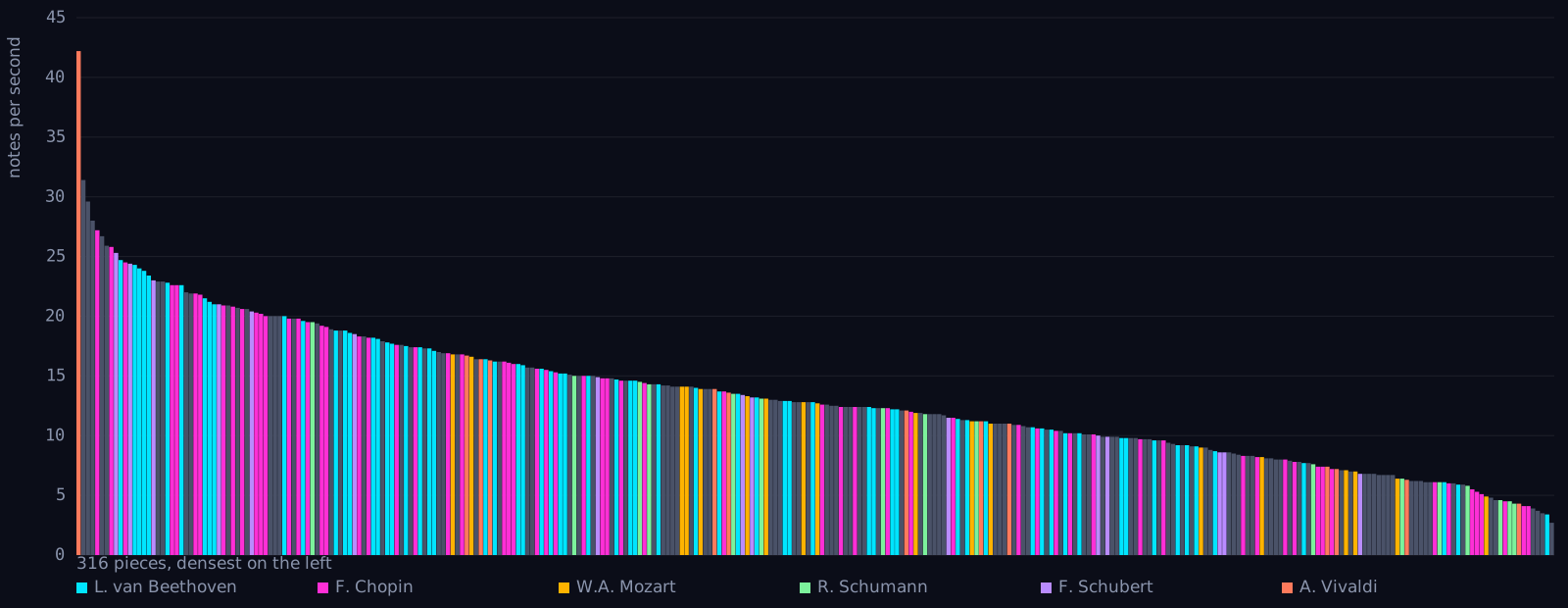
The densest twenty in the library
| # | Peak n/s | Notes | Length | Piece |
|---|---|---|---|---|
| 1 | 31.4 | 4,144 | 4:08 | F. Liszt · Un Sospiro |
| 2 | 29.6 | 6,760 | 8:45 | F. Liszt · Hungarian Rhapsody No. 2 |
| 3 | 28.0 | 4,064 | 4:21 | F. Liszt · La Campanella |
| 4 | 27.2 | 1,243 | 0:57 | F. Chopin · Prelude Op. 28 No. 12 in G# minor |
| 5 | 26.7 | 7,349 | 8:42 | F. Liszt · Hungarian Rhapsody No. 12 |
| 6 | 25.9 | 4,441 | 3:16 | F. Liszt · Transcendental Étude No. 5 |
| 7 | 25.8 | 5,614 | 6:33 | F. Chopin · Sonata No. 2 · I. Grave |
| 8 | 25.3 | 3,615 | 3:26 | F. Schubert · Wanderer Fantasy · IV. |
| 9 | 24.7 | 7,361 | 9:39 | L. van Beethoven · Waldstein · III. Rondo |
| 10 | 24.5 | 6,052 | 5:53 | F. Chopin · Polonaise "Héroïque", Op. 53 |
| 11 | 24.4 | 3,781 | 6:58 | F. Schubert · Wanderer Fantasy · II. |
| 12 | 24.3 | 13,924 | 21:16 | L. van Beethoven · Symphony No. 9 · IV. Finale: Ode to Joy |
| 13 | 24.0 | 5,331 | 5:01 | L. van Beethoven · Les Adieux · III. Das Wiedersehen |
| 14 | 23.8 | 7,223 | 7:45 | L. van Beethoven · Appassionata · III. Allegro ma non troppo |
| 15 | 23.4 | 6,377 | 9:18 | L. van Beethoven · Appassionata · I. Allegro assai |
| 16 | 23.0 | 4,665 | 5:52 | F. Schubert · Wanderer Fantasy · I. |
| 17 | 22.9 | 2,914 | 2:30 | M. Moszkowski · Étincelles, Op. 36 No. 6 |
| 18 | 22.9 | 3,402 | 5:16 | F. Liszt · Grande Étude No. 2 |
| 19 | 22.8 | 13,723 | 17:59 | L. van Beethoven · Symphony No. 6 · III–V. Gathering – Storm – Shepherd's Song |
| 20 | 22.6 | 4,775 | 6:33 | F. Chopin · Sonata No. 2 · II. Scherzo |
Two of those twenty are piano reductions of symphonies rather than pieces written for the instrument: the finale of the Ninth and the Pastoral's storm sequence. They are in the library, they are genuinely that dense, and we are not going to quietly drop them to make the list tidier. If you want the piano-only ranking, skip those two rows.
Four things the data says that the opinion lists do not
Liszt owns the top of the list, and it is not close
Five of the top six. That is not reputation, it is arithmetic: Liszt wrote more notes per second than anyone else in this library, consistently, across pieces written decades apart. Un Sospiro tops it at 31.4 notes per second, and Hungarian Rhapsody No. 2 is second at 29.6.
Length and density are different problems
Chopin's Prelude Op. 28 No. 12 is 1,243 notes and it is over in 0:57, and it is the fourth densest thing here. Beethoven's Ninth finale is 13,924 notes, eleven times as many, and it is less dense at 24.3. One will wreck your hands in a minute. The other will wreck your concentration over 21:16.
La Campanella is famous for the wrong reason
It sits third at 28.0 notes per second, which is genuinely near the top, but its reputation comes from the jumps rather than the density. The Hungarian Rhapsody No. 2, which everyone thinks of as showy rather than hard, is denser.
The gentlest famous pieces are gentler than you think
Satie's Gnossienne No. 3 peaks at 2.7 notes per second, which is one note every 370 milliseconds at its busiest moment. Schumann's Träumerei is 4.3. These pieces sound accomplished and sit in a range a beginner can reach.
The other end
| Peak n/s | Notes | Length | Piece |
|---|---|---|---|
| 2.7 | 598 | 4:52 | E. Satie · Gnossienne No. 3 |
| 3.4 | 493 | 4:07 | L. van Beethoven · Waldstein · II. Introduzione |
| 3.5 | 274 | 1:28 | M. Clementi · Sonatina Op. 36 No. 3 · II. |
| 3.7 | 336 | 2:13 | C. Debussy · The Little Shepherd |
| 3.9 | 755 | 6:25 | E. Satie · Gnossienne No. 1 |
| 4.1 | 491 | 2:25 | F. Chopin · Mazurka Op. 33 No. 1 |
| 4.1 | 342 | 1:54 | F. Chopin · Prelude Op. 28 No. 2 in A minor |
| 4.3 | 508 | 2:55 | A. Vivaldi · Autumn II. Adagio molto · Four Seasons |
| 4.3 | 456 | 2:07 | R. Schumann · Träumerei |
| 4.5 | 670 | 3:20 | R. Schumann · Kreisleriana · IV. |
Where the numbers come from
Each piece is a chart: a list of notes with a time, a duration, a pitch, a velocity and a hand. The peak figure is a rolling 25 second window over the note onsets, taking the maximum. Nothing is estimated and nothing is rounded up.
The full table for all 315 pieces is at the catalogue, sortable.
If you want to use this data, take it. Link back here and we are square.
What this has to do with us
Klaviero is a falling-notes piano game for MIDI keyboards. The measurements exist because the game needs them: to grade difficulty, to size the timing windows, and to tell you what you are walking into before you start a piece.