You have played the notes. Now find out whether you played the music.
The Klaviero Method grades what you actually did at the keyboard. Your rhythm and your rests, each hand on its own, the balance between them, and how you read something you have never seen before. Five numbers, and no overall score, because an average of five hides the one that tells you what to practise.
You need a MIDI keyboard. That is the reason the grading works. Klaviero reads note-on, note-off and velocity straight from your instrument, so it knows when you let a note go and how hard you pressed it. A microphone reports neither reliably. 65% of first-time piano buyers now buy a digital instrument, so this is the growing base rather than a niche. What you need, in full.
A Report, from a real session
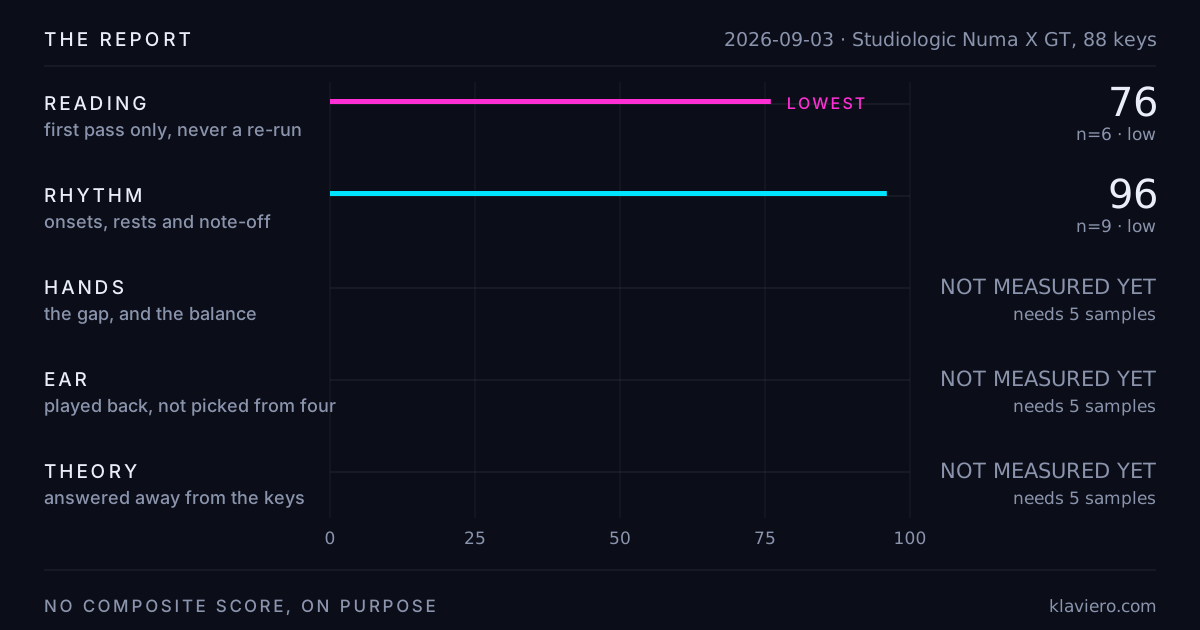
Five axes and no composite. A single score is what the rest of the category sells, and it is what lets someone believe an app that never checked their rhythm. An axis with fewer than five samples says NOT MEASURED YET, because a zero you did not earn is both a lie and the most demotivating thing a progress display can show you.
What it grades that nothing else does
Competitor claims checked on 2026-08-06
Simply Piano lets you play the wrong rhythm entirely and still gives you all green notes. Rests are the same story across the category: they are ignored, or you can skip one without penalty. In the Method rhythm is its own axis, and a rest you played through is a rest you missed.
Skoove never evaluates note-off, so you can release every note early and still score perfect. Klaviero reads note-off, so a phrase you cut short is graded as cut short and staccato is a thing you can get wrong.
Not one app in the survey behind this page tracks either. The Method measures the gap between your hands in milliseconds on notes written together, and the melody against the accompaniment in decibels, off the velocity your keyboard already sends. Play the tune louder than the chords is a first-year instruction and nobody else checks it.
Every Drill is generated fresh from the skill it tests, so it cannot be memorised in advance. Reading is graded on first pass only, because the second run of the same page measures memory instead.
Each of those four is checkable rather than asserted, and each one is a thing the Method computes from the MIDI you sent. Nothing on your Report is an estimate dressed up as a measurement.
10 Books
| Book | ABRSM, about | RCM, about | What it covers |
|---|---|---|---|
| 1 | Initial | Prep A | How to sit, how to drop your arm, where the keys are. No notation for the first seven Lessons, because no serious method starts there. You finish it playing with two hands. |
| 2 | 1 | Prep B to 1 | Two hands together while reading, eighths, and the same five-finger shape moved into other keys. Transposition starts here and never stops. |
| 3 | 1 to 2 | 2 to 3 | The major scale built from tetrachords, the thumb crossing under, and the first time your hands do two different things on purpose. |
| 4 | 2 to 3 | 3 to 4 | Hands-together scales, 6/8, and reading you have not seen before at a tempo somebody else chose. Roman numerals arrive, which most method books never mention. |
| 5 | 3 to 4 | 4 to 5 | Position stops being a cage. Arpeggios, inversions, triplets and sixteenths, and the right pedal used for a reason rather than for a wash. |
| 6 | 4 to 5 | 6 | The can-play-real-music threshold. Two voices, two articulations, two dynamics at once. Theory becomes a gate here, exactly as it does at ABRSM Grade 5. |
| 7 | 5 to 6 | 7 | A Bach two-part invention, played as two parts and not as one texture. The Report starts separating your hands from each other. |
| 8 | 6 to 7 | 8 | Four-octave scales, and the first genuinely interpretive decisions. Tempo becomes something you shape rather than something you hold. |
| 9 | 7 | 9 | A full page at sight, asymmetric metre, and playing from memory. RCM deducts marks for reading at this level and so does the Recital. |
| 10 | 8 | 10 | Scales in 3rds and 6ths, diminished sevenths from any note, and a programme rather than a piece. Past here it is a labour market, not a syllabus. |
Book 6 sits about where ABRSM Grade 5 sits. We say about because they are different tests. Your Report is the accurate answer.
A Book is not passed by watching it. A Lesson holds a handful of Drills and one Étude, a Drill is cleared or not cleared, and the Étude has to be played again as a Recital on a later day, so no Lesson can be passed inside a single day. Book 1 runs about ten to fourteen weeks at a real practice rate. That is slower than the category advertises and it is the speed the instrument actually moves at.
Book 1 is free, all of it, and needs no card
All 12 Lessons of Book 1, from how to sit down and drop your arm to playing with both hands. Placement is free. The Report is free forever. The Log and the review queue keep working on the free tier, because holding someone's practice record hostage to sell them something is the pattern this category is most resented for.
Book 1 is free and complete. Books 2 to 10 are not written yet. A plan opens the 4,296 charts in the player.
Prices read from the live checkout on 2026-10-25